• Home
  • Download
    • Premium Version
    • Free Version
    • Downloadable
    • Link Url
      • Example Menu
      • Example Menu 1
  • Social
  • Features
    • Lifestyle
    • Sports Group
      • Category 1
      • Category 2
      • Category 3
      • Category 4
      • Category 5
    • Sub Menu 3
    • Sub Menu 4
  • Travel
  • Contact Us

A Wedding & Burning Man

August 2017, Don & Era go to a wedding in Seattle then stir up the dust at Burning Man

Dear friends and family,

Our last meal in Spain was in Segovia at the restaurant, Jose Maria. We got a recommendation and directions from our hotel receptionist. Very cold, Christmas decorations up (it's Dec 27). 


Segovia town square.


The bar attached to the restaurant, a sort of Happy Hour going on, which lasts until God knows when. We arrived for dinner at 8:30, far too early for a self-respecting Spaniard to dine. We passed through the bar and there was almost no one eating in the dining room yet.


Spanish troubadores or tunas. Unfortunately we could barely hear them above the din.


Every fine restaurant in Spain has one, an entire Jamon Iberico. I don't know why they covered this ham's black foot; perhaps modesty.


First course - we couldn't resist: Jamon Iberico de Bellota or pata negra, acorn-fed ham. Delicious. We are probably dwelling ridiculously too long over this meal, but it was our last dinner in Spain. We're savoring (and slavering).

Both Don and Woody Allen have joked that bacon will some day be found to be good for you. Well, here is the Spanish thinking along those lines. From a British website which cites Spanish nutritional studies (http://www.ibergour.co.uk/en/jamon/beneficios_salud_jamon.html):

The fat of Iberico bellota ham contains over 55% oleic acid (a mono-unsaturated fatty acid). Rigorous scientific studies have shown that these fats exercise a beneficial effect on cholesterol in the blood by increasing the amount of good (HDL) cholesterol and reducing bad (LDL) cholesterol. Only virgin olive oil has a higher oleic acid content.

The total proportion of unsaturated fatty acids in cured Iberico hams that have consumed a diet of acorns is over 75%, making it the most "cardiohealthy" of all animal fats, even healthier than some fats of plant origin. The breed of pigs is not the only explanation; their staple diet of acorns and grasses also plays an important role.

In addition to its beneficial effect on cholesterol, Iberico ham provides proteins, vitamins B1, B6, B12 and folic acid, all highly beneficial for the nervous system and proper functioning of the brain. It is also rich in vitamin E, a powerful antioxidant, and in minerals such as copper, essential for bones and cartilage; calcium, iron, zinc, magnesium, phosphorus and finally, selenium, which has been attributed with antiaging properties.

With regard to calories, 100 grammes of Ibérico bellota ham provides less than 250 kcal (roughly the same as bread) meaning that, eaten in moderation, it can be included in low calorie diets.

It is also an excellent substitute for red meat: 100 gramof ham contain 43 grs. of protein.
The fat of Iberico bellota ham contains over 55% oleic acid (a mono-unsaturated fatty acid). Rigorous scientific studies have shown that these fats exercise a beneficial effect on cholesterol in the blood by increasing the amount of good (HDL) cholesterol and reducing bad (LDL) cholesterol. Only virgin olive oil has a higher oleic acid content.

The total proportion of unsaturated fatty acids in cured Iberico hams that have consumed a diet of acorns is over 75%, making it the most "cardiohealthy" of all animal fats, even healthier than some fats of plant origin. The breed of pigs is not the only explanation; their staple diet of acorns and grasses also plays an important role.

In addition to its beneficial effect on cholesterol, Iberico ham provides proteins, vitamins B1, B6, B12 and folic acid, all highly beneficial for the nervous system and proper functioning of the brain. It is also rich in vitamin E, a powerful antioxidant, and in minerals such as copper, essential for bones and cartilage; calcium, iron, zinc, magnesium, phosphorus and finally, selenium, which has been attributed with antiaging properties.

With regard to calories, 100 grammes of Ibérico bellota ham provides less than 250 kcal (roughly the same as bread) meaning that, eaten in moderation, it can be included in low calorie diets.

It is also an excellent substitute for red meat: 100 gram

I dunno, I always thought ham was considered a red meat. I am happy to hear of any excuse to eat this delicious substance. I only include this to absolve you of any guilt when you do go to Spain or your next Spanish restaurant.


Grilled asparagi and zucchini with shrimp; also scrumptious.


More shrimp or langoustine, grilled. Yummy.


A regional bread soup. Don liked it; I could take it or leave it.


No room for dessert, but this does remind us of the restaurant's name. A rather eccentric meal by Spanish tastes, but that's what we felt like eating.

This is the restaurant where the cute little piglet was broiled or baked and then quartered with the edge of a plate, making that unsettling crunching sound. The attractive young lady at the next table ate it with a big smile.

Back to our super comfy room at Hotel Don Felipe for a great night's sleep. Drove next morning to the Madrid Airport; had a frustrating time delivering the rental car to the right location, caught our Vuelling flight with no problems, arrived in Paris, CDG, took the train into Paris. Freezing. Don was really in the mood for Soupe de Poisson, but that's another story.


On our drive out of Segovia, we stopped and got this photo of the Roman aqueduct. Discovered if you click on these horizontal panoramas in the blog, they blow up a little larger.


Now for the D&E Starred Recommendations for Spain. Inspired by the Michelin Guide, as all the starred lists are. In deference to the Michelin, I decided to keep it to 3 stars as the top rating, but with a twist. For instance, I will do half stars.
3 stars (***) means highly recommended, a worthy destination for an extended (more than a few days) visit, and in fact we would go back.
(**.5) stars means worth a side trip or a significant detour
(**) stars means worth a small side trip
(*.5) stars means picturesque, worth a stop over if you were going that way anyway
(*) star means worth a stop over if you were going that way anyway, but might be difficult to reach (traffic, narrow winding, crazy streets, etc.)
(0) means don't stop
All ratings are totally subjective and our taste may not agree with your taste. In fact, our taste can sometimes be a little quirky.

In order of our trip:

Madrid (***) - Just for the food and museums alone. We went to the Prado and the Thyssen-Bornemisza, which were both fabulous. Mel Ramos recommended these and also the Reina Sofia Museum -- which was recommended by many and which we did not have the time to see :-(  -- and the Joaquin Sorolla Museum.  Squeak Carnwath recommended a little church in Madrid on the outskirts of town which has some very beautiful Goya frescos on the ceiling. So obviously we have to go back.

Toledo (**) - unless you are a big El Greco fan. For historical interest, it's important. Too fastidiously clean for us (as in cleaned up for tourists).

Plasencia (**.5) - a small, but charming town. 2.5 stars for the amazing parador. Good food.

Caceres (***) - Gorgeous historical city. Great to walk around. Can't say anything about the museums as they were closed for the holidays. Also the Fluxus Museum and the amazing natural environment on the outskirts of Malpartida de Caceres. Good food.

Merida (**) - A little over 2, really. Some nice Roman ruins. The archeological museum was closed when we were there. I've heard it's a good one. Designed by Rafael Moneo. Good food.

Ciudad Rodrigo (*) - Worth staying over, if you are driving that way, from Madrid to Portugal or vice versa, and you happen to hit it at the right time of day. Otherwise, we wouldn't bother. Hard to get into - little winding roads

Salamanca (***) - I have to give it 3 stars, although we were there for only a few hours. Beautiful city.

Segovia (***) - Close to 3 stars, but it is not very large. Charming, beautiful small city. Again, we were not there very long. Would definitely go back, even though it is hard to drive in with their little winding roads. It is fairly close to Madrid, so would probably return by train next time.

Also, on a previous trip to Southern Spain we went to:

Granada (***) - The Alhambra is a dream, incredible Moorish architecture and gardens; wouldn't book a long stay here as the city is pretty small.

Cordoba (***) - Smallish old medieval town with the mind-blowing Mestiqua; wouldn't book a long stay here as it's even smaller. Barely squeezing into the (***) category. Good food.

Seville (***) - Beautiful, fun city. The palace is second only to the Alhambra; gardens are lovely.

Love,

Era and Don
Hi friends and family,

Christmas in Caceres; everything appeared closed. Our hotel did not know if even the churches would be open - "Perhaps." And the day was overcast, a definite drop in temperature, to about freezing. I told Don we might have to be on an enforced diet that day (which wouldn't hurt us a bit, I know), since we had eaten all available snacks the evening before.

We got in the car for sightseeing in the direction of Merida, a town with a few Roman ruins still recognizable. This area of Spain had been settled by the Romans pretty extensively. Passed a lot of bulls in acorn tree-studded pastures, which we commented upon. This is not a sight commonly seen in the US. We are used to seeing lots of cows and an occasional bull. This mystery and the lack of pig sightings was cleared up for us by Mel Ramos:

Your trip to Spain sounds very familiar. The area between Avila and Salamanca has many many oak trees that drop acorns. These ranchos raise Toros Bravos (fighting bulls) and as the tale goes the bulls eat the acorns and it gives them a bad case of gas making them fart a lot. This is what makes them so pissed off. The reason you don't see pigs grazing is because they are all raised in granjas, (indoor pens) along with chickens, and rabbits. Cows and sheep graze outdoors.


Spotted this ruin of an aqueduct on the outskirts of Merida, also a convenient stork roost.

Rather annoying, but the old Roman ampitheater and a neighboring temple were enclosed by barbed wire and a wall of hedges, which was closed on Xmas day. We snuck some photos through a gap in the hedge, but they have been deleted from this email for lack of space.

Hey, there is a parador in Merida. They have customers staying with them; they might serve food.


To the Parador, Merida.

Not fasting after all. Our Christmas dinner. We burst into the dining room as soon as it opened, which was 2:00 pm.


Trying to decipher the Spanish menu. The parador was serving a special Menu Almuerzo Navidad 2010 (Special Christmas Dinner). The martini glass holds a very creamy foie gras; you also see croquetitas de perdiz (croquettes made of quail - I think) and Lascas de Lomo Iberico (some type of Iberian ham).


Era staring down a prawn (Ensalada de Langostinos al Vinagre balsamico).


Future Doctor - some things are the same the world over; a kid doing his best to amuse himself.


Don doesn't seem to be able to direct Era's gaze towards the camera. Apparently she is fascinated with her food.

Our main course: Don had the Navidad dinner menu entree: Cochinillo Asado acompanado de patatitas salteadas. It had been described to us as pork so tender that it could be cut with a fork and would melt in your mouth. It was delicious and incredibly tender. We found out afterwards that this is because it is from a little baby suckling pig which hasn't had time to develop any muscles. We saw one later in a Segovian restaurant window, lying small and uncooked with a smile on its face, looking adorable, as if it were happily sleeping on a bed of crushed ice. Someone at this same restaurant in Segovia ordered it at a neighboring table and they brought it to them, roasted with crispy skin and quartered it with the edge of a dinner plate - with a disconcerting crunching sound - which is the traditional way it's done, to show how tender it is. Fortunately, for us, we had no idea this is what we were eating, and so totally enjoyed it.

I was already a little overdosed on pork, so asked for fish and received some lovely sea bass on a sort of tapenade of eggplant, peppers, onions.


Our waitress, showing us the Cava (Spanish champagne) we are about to have with our dessert. We also quaffed a Chardonnay de Torres - D.O. Penedes and a delicious Vino Tinto Muriel D.O. Calificada Reserva 2004. Not sure what type of red wine this was, but it was so good we looked for it in different wine stores afterwards and could not find it. The cava was Cava "Juve Camps" Reserva Cinta Purpura. Those little wrapped goodies on the plate are great little Spanish cookies and candies. We are bringing some back to the Magnolia crew. They also served us a sort of cheesecake with apricot inside and fresh fruit.

And now some hardware shots for the men. We, especially Don, became obsessed with the beautiful door hardware and studs.


Our after dinner stroll, we took in the Temple of Diana, which once stood at the crossroads of 2 major Roman roads. This was right on a small central street in Merida. It seems that they are building a museum to surround it.


More Temple of Diana.


Roman bridge, street lights have been added since. And that was our Christmas, folks. Our daughter, Marisha, says that her white Christmas is mostly white concrete and plaster dust covering all the surfaces of our house. She was able to escape for a Christmas Eve feast with her Farnsworth grandparents and some other family, and a Christmas day feast with Squeak Carnwath and Gary Knecht. Thank you, kind hosts, that relieves some of our guilt and makes us feel a little less like bad, bad parents.

Love,

Era and Don
Hi friends and family,

Finally, a travel blog! We've been on the road for about a week, but it's been mostly busy schedules, work and 5 hours sleep a night, jet lag, different emergencies, so no time or energy to pound the keyboard.

We wouldn't normally choose to travel to Europe, especially Northern Europe, in the middle of winter, but the opportunity came up to meet Chuck Close in Belgium to do some weaving/filming, while at the same time we are having major work done on our house, so it wasn't too hard to convince us to go.

First stop was Palm Springs, where Deborah Oropallo is having a show, and where the gallery, Melissa Morgan, was also showing a number of Magnolia tapestries. The Palm Springs Museum of Art has a Deborah Oropallo tapestry and is pondering acquiring another major tapestry. The Museum's collectors group had a wonderful holiday dinner at the gallery. Dining at a long table, surrounded by tapestries, gave the banquet a festive, quasi-medieval feel. Don and Deborah were invited down to give a short talk. As well as Deborah, Stephen Nash was there, now director of the Palm Springs Museum, so some old friends.


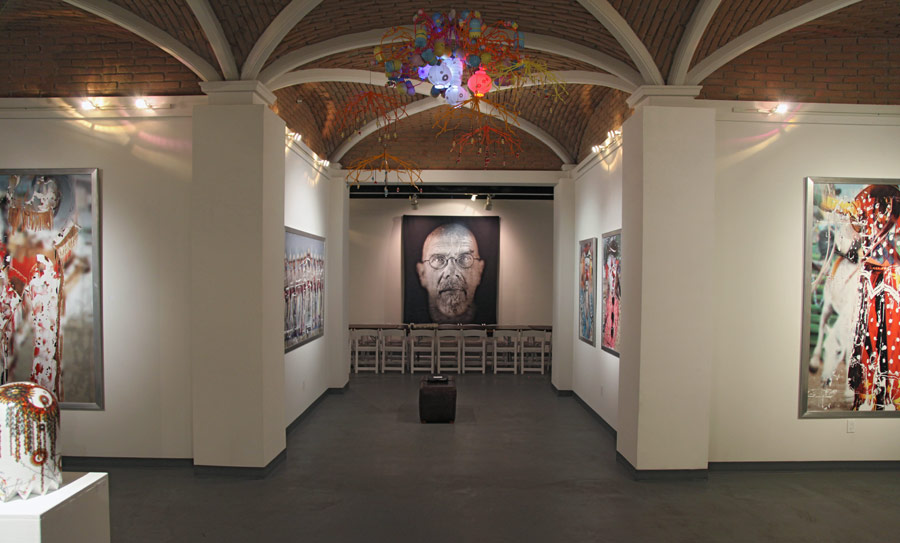
Oropallo pieces seen in foreground and on side walls; Chuck Close tapestry on the other side of banquet table. More tapestries to either side of Chuck.

Left after the feast and drove to LAX, in preparation for a 6:30 am flight to NY (which as you can imagine means getting up at 4:30 am). Short layover in NY, while we waited for our Open Skies flight to Paris. This is a relatively new all business class airline, which I was excited to take. We had just settled into the Open Skies lounge when Don checked his messages. One of our credit card companies had called; apparently one of our major credit cards had been compromised. Someone had managed to get our card information and was using it fraudulently. Fortunately, for us, they weren't too bright, as the first thing they did was buy some porn, which sent up a red flag. The credit card company had to cancel our card and FedEx another one to the Belgian mill. Fortunately, we had brought some other cards.

For those who were curious, the Open Skies flight was very nice, very comfortable, especially after we figured out how to adjust the complicated seats. Here is Don enjoying his seat. Open Skies prices are much more reasonable than a regular business class seat.


Seats recline way back, but not totally flat. There is a small section with seat beds, but they were sold out. Food and drink is better than decent.

And here is a shot of our house construction. As you can imagine, a lot of both dirt and concrete dust, which permeates the entire house. This is a picture of our downstairs. Our construction crew refers to it as The Pit of Despair. They've been digging down there for weeks, along with pouring new foundations. There will be three huge loads of concrete altogether, in three separate pours. Our daughter, Marisha, is staying behind and supervising. What a trooper. She is also our architect on the project; she's in the midst of the masters program in architecture at Berkeley. What a grind that is; talk about the pit of despair.


We spent our first few jet-lagged days staggering around Paris. Beautiful, but cold weather; snow on the ground. Staying right around the corner from Rue St. Andre des Arts, Allard's, Malongo (our favorite coffee place in Paris) and a Mariages Freres. Brilliant location, but a teeny apartment. However, it had a comfortable bed and plenty of hot water, so no complaints. 


Louvre at night, which happened around 5:00 pm.

The food section: Taking a tip from What the Wild Things Ate by restauranteur Michael Wild, David and Jill Wild (available thru the Magnolia Editions web site under Books and Publications and also from Blurb), we chose a restaurant near the Louvre, La Regalade Saint Honore. We were helped in this choice by our sister-in-law Karen. Thank God we had given her a copy of What the Wild Things Ate as our copy didn't make it into our suitcase and we were able to email Karen, who kindly sent us all relevant Parisian restaurants. Following is for our foodie friends, who have actually complained that our more recent travel blogs did not have enough food content.


La Regalade starts everyone off with a paté - I think it was duck, pickles in a little jar, and baguettes. Great with our Bordeaux.


Don's appetizer: calamari cut into thin slices so that it resembled noodles, with pieces of bacon and croutons, over a black squid ink risotto. Delicious. Can't see much of Don, but enough to see that he's smiling.


My appetizer: scallops poached in a fabulous sauce also with chunks of bacon and croutons with parmesan. Also delish, but I think Don's was more inventive and maybe a bit more scrumptious.


Pork belly with a crispy finish on lentils. This won rave reviews from a food blogger. I think Don thought it was a bit heavy with all his other food.


My main course: Sea bass on baby potatoes. Flawless. 

And for some reason I neglected to take pictures of the desserts, which were a pear and apple crumble for Don; and a pot de creme with passion fruit purée for me. They actually gave me two, and I had to give one to the table next to us. A couple of Parisians having a business lunch, who didn't look the least bit overweight, but managed to eat all their courses. La Regalade also gave us madeleines at the end of the meal, which nobody seemed to eat. We took ours "home" and had them with next morning's coffee. 

Had a conversation with the waitresses about California food and produce. We have quite a reputation; they were sufficiently awed, especially for Parisians. Told them that Michael Wild of Baywolf recommended La Regalade to us. One waitress seemed to have heard of it.

On to Belgium.

Much love,

Era and Don
Hey, you guys,

Thanks to some of you for writing in your embarrassing dining stories, which we enjoyed so much (and which Don especially very much appreciated). I am copying a few here. The names have been deleted to protect the innocent.

Hello Don and Era,
We both enjoyed your travelogue.  Especially enjoyed the story of the unshucked shrimp!  I have a similar story of a pea being sucked into the nasal cavity accidentally, and then exiting in a sneeze and landing on the plate of the Duchess of Something or Other.  And being terribly polite, she simply ate around it.
Vicarious travel is great, and such a bargain.


Dear Era and Don,
It's great being on your travel blog. It is almost like being there. Don's shrimp faux pas is the kind of thing I usually do. But usually mine involves spilling a glass of wine (red of course) on my dinner partner (usually a woman and always her glass since I don't drink).

Dear Era,
You may remember the story of my waitressing days: when holding a tray overhead to clear some passing diners, I inadvertently allowed a full plate of enchiladas to slip off the tray behind me, landing on the unsuspecting head of a businessman who was in the middle of a business lunch. It proceeded to slither down the back and front of his gray suit. His fellow diners got a good laugh out of it and thankfully he had a sense of humor also. I was mortified.


Thank goodness for good humor,

Era and Don
Hi all,

How the monks can make this delicious food without meat, fish, onions, garlic or dairy is amazing. They've been practicing, practicing for over 1100 years.

We arrived in Koyasan after taking the bullet train to Osaka Namba Station, a huge station with several different shopping plazas, then a local "express" and then a cable car up a very steep mountain, and finally a short bus ride to our beautiful temple. We will write more on Koyasan later; this is just the start of the food. This is the gorgeous Daienin, where we stayed.


Don and I have just been served 2 red lacquer trays each, laden with food. The dinners are served normally at 5:30, but since we arrived late (at 5:30) they served us at 5:45. We weren't really hungry yet, but we did our best.


On the closest tray, starting again with the tempura and proceeding clockwise.

The tempura is grated carrots with some chopped green herb. Delicious. Also there was green pepper, eggplant, squash and potato. I could not begin to finish this.

Tempura dipping sauce in small blue and white bowl.

Sake cup for a special sake the monks make in Koyasan. Very good and also supposed to be medicinal (good for the nerves).

The red lacquer bowl with sprays of gold contains a clear soup with noodles, a decorative tofu shaped like eggplant, strips of fried tofu and lemon slice.

Rice, which we wouldn't be eating until later in the meal if we were proper Japanese.

3 kinds of pickles. Very good, not as salty as the type we get in the States.

In the squarish bowl, a delicious salad consisting of shirataki (clearish, white noodles made from konnyaku, I think), slices of devil's tongue jelly (a different grade of konnyaku, slices of different vegetables and seaweed. All in a vinegary marinade/dressing. There was more to this salad; it's partially eaten.

In the red bowl, my absolute favorite. What is called Goma-tofu. It is made with sesame seeds and starch, as well as the usual soy beans, I guess. It is in a sauce with a little mound of wasabi on top. This is apparently a secret recipe passed down from monk to monk for 1100 years. I have never had anything like it. It tastes like the lightest, most delicious cheese with a very creamy, cheese-like consistency. I hope they give us some more tonight.

Tray #2, starting with the eggplant and proceeding clockwise.


Grilled eggplant. Half of it has a dark miso sauce. The lotus root has been pickled in rice vinegar. The 2 green vegetables under the lotus root are okra.

A miso nabe, or stew, in a wire net which has been lined with a stiff paper. There is a flame underneath, the stew is simmering in the paper and nothing burns. The stew has more normal, but very good tofu, clear noodles, shiitake mushrooms, mochi (which is a rice cake made from pounded sticky rice), all in a miso broth.

In the small blue and white striped, hexagonal bowl, a vegetable which has been stewed in a gelatinous broth. I wish I could describe the flavors better, but it seems beyond me. I think this vegetable may be the type of gourd which is dried and made into a loofah. I can't think of the name, but I've had it before. Very delicate and good.

The white bowl is for the nabe (stew).

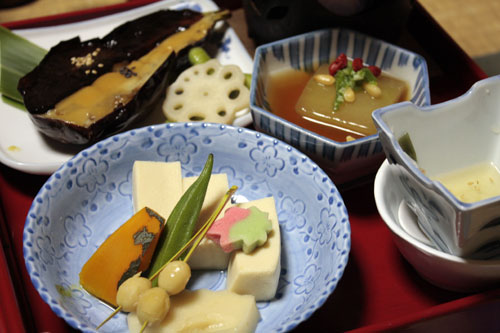
The blue flowered bowl has tofu, a very different type. It was extremely juicy, had soaked up a lot of delicious sauce. I wish I could describe or figure out how they make their sauce without onions, fish or meat. I can't imagine what the base is. The rest of the dish is Japanese pumpkin, okra, gingko nuts, and a decorative piece of tofu shaped like a maple leaf.

Dessert was Japanese pears and grapes.

BREAKFAST the next day


As if we were hungry.

Starting at the top LH corner, tofu with bits of vegetables and seaweed mixed into it, formed into a patty. Again, very juicy with broth. 2 pieces of an unidentified mountain vegetable on top which has also been stewed.

A clear broth with chrysanthemum leaves, enoki mushrooms, and tofu in the iron pot with the flame under it. Not easily seen in this photo, but there was also a flat square of what looked like a very fine moss. It fell apart when touched and made a beautiful pattern in the clear broth.

A little dish of soy sauce.

In the turquoise bowl to the side, gobo or burdock root, marinated with toasted sesame.

In the white bowl underneath, bowl for the broth with a lime to squeeze into it.

Back on the tray, miso soup with seaweed and a frothy sort of tofu.

Teacup and rice bowl.

Pickles and salted plum.

Wish you could be here to help us with all this food.

Love,

Era and Don
Hi friends and family,

By popular request, a Japanese food email. Mostly pictures.


This is a fairly typical Japanese lunch, especially in this hot, humid climate: cold buckwheat noodles (soba) with shredded dried nori (toasted sheets of seaweed) on top, a dipping sauce into which sliced scallions and wasabi is mixed. Dip cold noodles into cold dipping sauce and slurp away. Tempura'ed shrimp also over soba in a clear, dashi-based sauce with chopped scallions. This is served hot. Again, slurp away. We had this at a small restaurant at Daikoku-ji Temple, Kyoto.


Sashimi with intricately carved carrots. Don't ask me what the different fish are. I know one of them was sea bream. Very delicious, but we later went back to another restaurant which was equally delicious and served larger servings. Does anyone really care about those gorgeously carved carrots? Chandra and I had this at a restaurant in Pontocho, the (I think former) geisha in training area in Kyoto.


A beautiful and delicious kaiseki meal at a Tokyo restaurant recommended by a Japanese friend of Lewis'. We had another beautiful kaiseki dinner in Naoshima, but it just didn't measure up in taste. I don't even know the name of this restaurant, as I never saw it written in anything but calligraphy, but it was in the Ginza in a building called the Jujiya (or perhaps Jijuya) building, across from Matsuya Ginza, next to Chanel and on the 5th floor of the building. As Lewis' Japanese friend said, she took some friends there and they said it was the most sublime dining experience they had had in all of Japan. I think we all agreed - sublime. It came to about $30 each, including the beer. Great value. Cooking like this is incredibly labor intensive.

The first course is salad with a lovely dressing and tuna sashimi in the cantaloupe bowl. The little glass holds the dressing. The little round bowl contains what I think is a tofu and root vegetable mixture lightly fried or perhaps baked and then stewed in a savory jelly-like sauce, apparently made glutinous by some mushrooms. Very subtle and delicious, although it may not sound that way.


The main course: Starting from what we all know, the tempura, shrimp, eggplant, some type of green pepper.

In the bowl shaped like a yellow and green leaf: some type of tofu baked with what appeared to be raisins inside of it, sesame on top - Not my favorite; the red ball made to look like a little fruit is actually a small egg yolk of a bird smaller than a chicken, marinated in something which made it go clear and red; grilled eel sushi with a piece of pickled ginger.

In the white eye-shaped bowl: a salad of seaweed, cucumber, fried tofu, sliced and marinated, and a Japanese dried gourd, sliced and marinated. Excellent.

In the little square blue dish: I think this was some type of almond milk jelled and cubed (or made from some sort of nut), with a caviar sauce.

In the polka dot cup: Chawan mushi, a savory egg custard (not sweet). It usually has little bits of shrimp and fish, perhaps vegetables inside.

In the red lacquer cup: A cube of tofu with sauce.

In the shallow bowl to the side, a dipping sauce.

There was a rice course with shredded egg and other things, which we all forgot to photograph. Can't remember very exactly now.


Dessert course: Very good ice cream, which had bits of rice in it. It was rice flavored. Japanese apple pear in the little maple leaf plate.

Just this evening (back in Kyoto) we found a restaurant which served delicious Japanese vegetable dishes, buffet style, over 20 items to choose from, and brown rice. Just what we had been hoping for. Then we heard from Lewis and Chandra, back in Napa. They just had an Italian dinner at some friends' house with a bottle of Napa red wine, that doesn't sound bad either.

Last night we broke from Japanese food, went to a Spanish restaurant and had Sangria, grilled vegetables, a tortilla and a paella. Not as good as Cesar's or our paella, but it was pretty darn good. Our waiter was a young Japanese who spoke English and Spanish and has traveled to 13 Latin American countries on his own. He said Era looked like his mother, and the family is from the Kyoto area. Don has not been feeling tip top and the Sangria helped to settle his stomach.

Tomorrow we go to Mt. Koya (Koya-san) to stay in a Buddhist temple for a couple days. One of the attractions is all vegetarian food which the Buddhist monks have been developing for centuries. Then we float home. But I'm very behind on my emails. Still have to tell you all about Tokyo and our opening. Hopefully I'll get to that before we return home (maybe on the plane) or it will never be written.

Best to all, and Envision Obama as President,

Era and Don
Older Posts Home

ABOUT AUTHOR

LATEST POSTS

  • Chuck's Beach House Birthday
    Hello friends and family, On another trip, even though I did not get a chance to finish telling you about the end of our last trip. We have ...
  • Japan Email #9 Hokusai and Kurashiki
    Dear Friends and Family, Seems that many people enjoyed those Miyajima posts. Miyajima is considered to be one of the 3 most scenic sights /...
  • Tokyo, mostly pictures
    Hi Friends, It's been said a million times, I'm sure, but Tokyo is a city of great contrasts. We're going to tell this story mos...
  • August 2017-a wedding & Burning Man
    Hi friends and family, We have had a very active August. Wedding in Seattle, Burning Man, getting ready for our opening in Santa Fe at...
  • Jodhpur Part 2
    Dear friends and family, Before we leave Mehrangarh Fort, I always love seeing the maintenance, the installation, the repair, the work going...
  • Christmas dinner in Paris
    Dear Friends and Family, It was supposed to rain on Christmas. We spent the morning holed up in bed, reading and napping. We ventured outsid...
  • Tokyo, The Missing Peace
    Hi folks, We came to Japan to attend the reception of The Missing Peace in Tokyo. The location is Hillside Terrace, an art space near Shibuy...
  • Followup: More embarrassing dining stories
    Hey, you guys, Thanks to some of you for writing in your embarrassing dining stories, which we enjoyed so much (and which Don especially ver...
  • Day 4 Kyoto, Fushimi Inari
    Dear friends and family, Day 4 After 2 days at our beautiful, but somewhat westernized ryokan, Watazen, in central Kyoto, we had to move. Le...
  • Japan Email #8 - Miyajima 2 - the long trek
    Dear friends and family, More Miyajima; it was a very full day.  Era in purple.  Don finds it difficult to pick me out of crowds here. I may...

Categories

  • belgium
  • budapest
  • florence
  • food
  • frankfurt
  • germany
  • Herculaneum Dec 2013
  • italy
  • japan
  • Japan November 2014
  • memphis
  • miami
  • Naples
  • nobel museum
  • nyc
  • palm springs
  • paris
  • Pompeii
  • romania
  • spain
  • stockholm
  • venice
  • washington dc

Recent Posts

About Me

Donald and Era Farnsworth
Donald and Era Farnsworth are collaborators in art and life. Married over 30 years, they co-direct Magnolia Editions and The Magnolia Tapestry Project, based in Oakland, California. Both artists are products of the SF Bay Area. Shortly after receiving his M.A. from the University of California at Berkeley in 1977, Donald Farnsworth met Era Hamaji. They married and immediately set out for Dar es Salaam, Tanzania where Donald designed and helped build a handmade paper mill while Era worked with artisans, teaching and developing new craft products lines. In 1980 the Farnsworths returned to California and were founders of the art projects studio Magnolia Editions, known for its innovative techniques and innumerable collaborative projects with artists.
View my complete profile

Blog Archive

  • ▼  2017 (1)
    • ▼  September (1)
      • August 2017-a wedding & Burning Man
  • ►  2016 (25)
    • ►  October (5)
    • ►  June (9)
    • ►  May (2)
    • ►  January (9)
  • ►  2015 (3)
    • ►  December (3)
  • ►  2014 (12)
    • ►  December (2)
    • ►  November (7)
    • ►  January (3)
  • ►  2013 (25)
    • ►  December (8)
    • ►  July (10)
    • ►  March (4)
    • ►  February (3)
  • ►  2012 (2)
    • ►  February (2)
  • ►  2011 (5)
    • ►  May (1)
    • ►  January (4)
  • ►  2010 (33)
    • ►  December (8)
    • ►  October (10)
    • ►  September (2)
    • ►  May (13)
  • ►  2009 (6)
    • ►  October (4)
    • ►  September (2)
  • ►  2008 (9)
    • ►  October (9)
Powered by Blogger.

About Me

Popular Posts

  • Chuck's Beach House Birthday
    Hello friends and family, On another trip, even though I did not get a chance to finish telling you about the end of our last trip. We have ...
  • Japan Email #9 Hokusai and Kurashiki
    Dear Friends and Family, Seems that many people enjoyed those Miyajima posts. Miyajima is considered to be one of the 3 most scenic sights /...
  • Tokyo, mostly pictures
    Hi Friends, It's been said a million times, I'm sure, but Tokyo is a city of great contrasts. We're going to tell this story mos...
  • August 2017-a wedding & Burning Man
    Hi friends and family, We have had a very active August. Wedding in Seattle, Burning Man, getting ready for our opening in Santa Fe at...
  • Jodhpur Part 2
    Dear friends and family, Before we leave Mehrangarh Fort, I always love seeing the maintenance, the installation, the repair, the work going...
  • Christmas dinner in Paris
    Dear Friends and Family, It was supposed to rain on Christmas. We spent the morning holed up in bed, reading and napping. We ventured outsid...
  • Tokyo, The Missing Peace
    Hi folks, We came to Japan to attend the reception of The Missing Peace in Tokyo. The location is Hillside Terrace, an art space near Shibuy...
  • Followup: More embarrassing dining stories
    Hey, you guys, Thanks to some of you for writing in your embarrassing dining stories, which we enjoyed so much (and which Don especially ver...
  • Day 4 Kyoto, Fushimi Inari
    Dear friends and family, Day 4 After 2 days at our beautiful, but somewhat westernized ryokan, Watazen, in central Kyoto, we had to move. Le...
  • Japan Email #8 - Miyajima 2 - the long trek
    Dear friends and family, More Miyajima; it was a very full day.  Era in purple.  Don finds it difficult to pick me out of crowds here. I may...

Advertisement

Copyright © 2015 A Wedding & Burning Man. Designed by OddThemes